
Evidence #19
10 charts on dying serendipity, gendered politics, blue-collar booms, aging economies, media fearmongering, cognitive decay, unkillable keyboards, flatlined AI adoption, and the paradox of progress.


Evidence is a dinner series with the purpose of enabling relationships through meaningful and open discussion. Each guest contributes a chart for discussion that is “evidence of a changing world.”
The Evidence at a Glance:
Serendipity is dead. 50% of couples now meet online, and a youth countermovement is fighting to bring serendipity back.
The sexes diverge. A 40-point ideology gap between young men and women is fracturing politics and society.
The toolbelt generation. Trade school enrollment surged 1,421% as youth bet their unautomatable hands against the laptop class.
Pyramids become obelisks. By 2100, every age group will be the same size, forcing a massive reallocation of capital toward eldercare.
Pensioners outearn workers. In France, retirees make more than the adults subsidizing them.
Misallocated fear. Heart disease causes 29% of US deaths and gets 2% of media coverage. Homicide and terrorism dominate the headlines.
The reverse Flynn effect. Global IQ scores are declining across all education levels, and screens may be the culprit.
QWERTY won’t die. A 153-year-old keyboard layout still dominates daily life, but voice and neural interfaces may be the future.
AI adoption: flatlined. Daily AI use at work is growing more slowly than headlines suggest. Compliance, energy, and institutional inertia are winning.
Awful, better, fixable. The world is devastating and better than it has ever been. Our inability to hold both truths is what keeps us stuck.
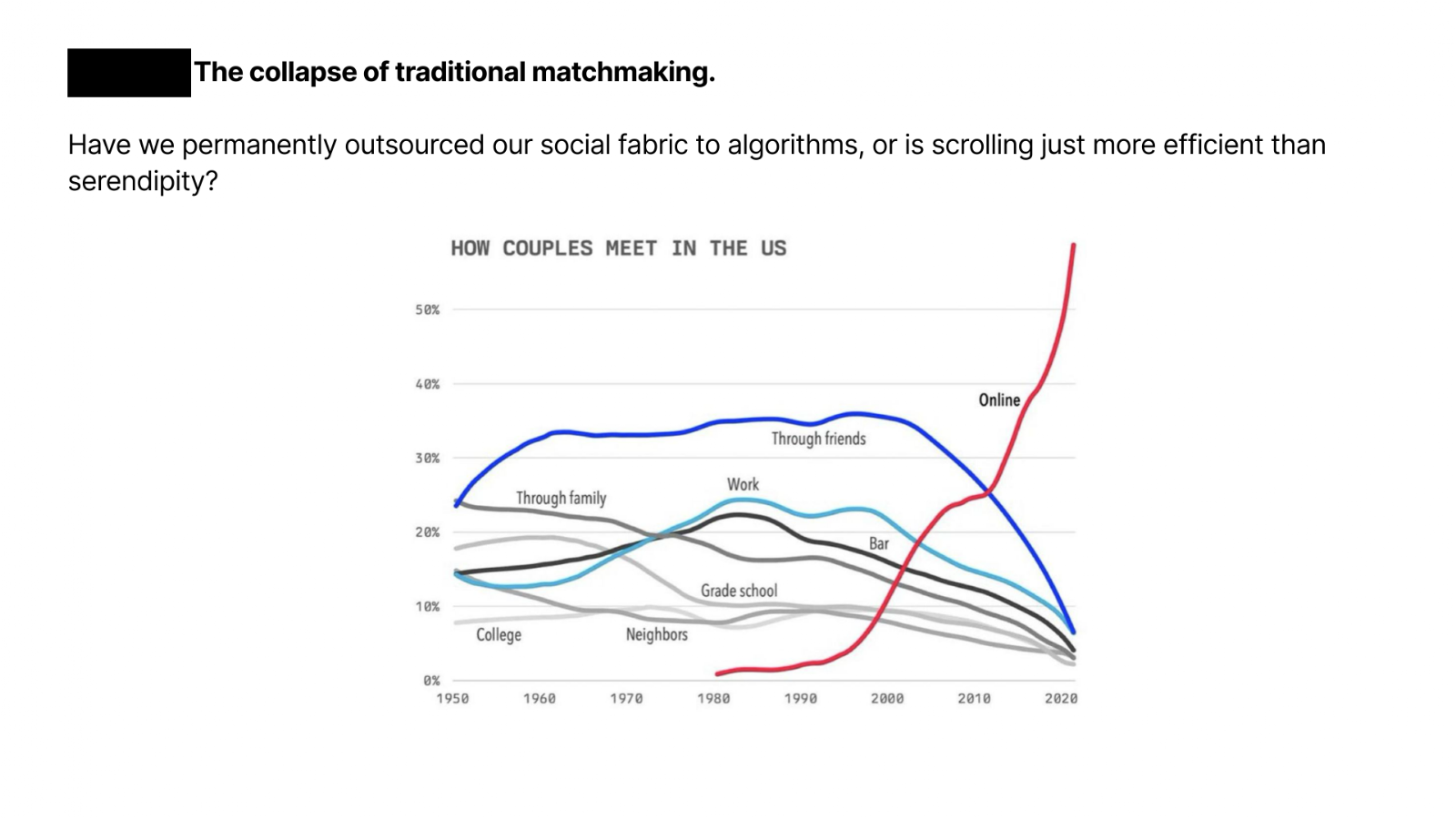
By 2020, 50 percent of US couples met online, overtaking every traditional avenue of human connection combined. The decline of institutional religion and physical third spaces opened a social void that dating apps rapidly filled. But infinite digital abundance has paradoxically engineered widespread isolation and swipe fatigue.
There was an interesting discussion about the reaction: a youth-led countermovement is rebuilding friction on purpose. Apps like Date Drop limit choices to one curated match per week. Thursday pushes connections to in-person meetings immediately. Gen Z is also driving a revival of physical gathering spaces and showing renewed interest in traditional religion, actively seeking the structured communities that algorithms can’t replicate.
Further reading
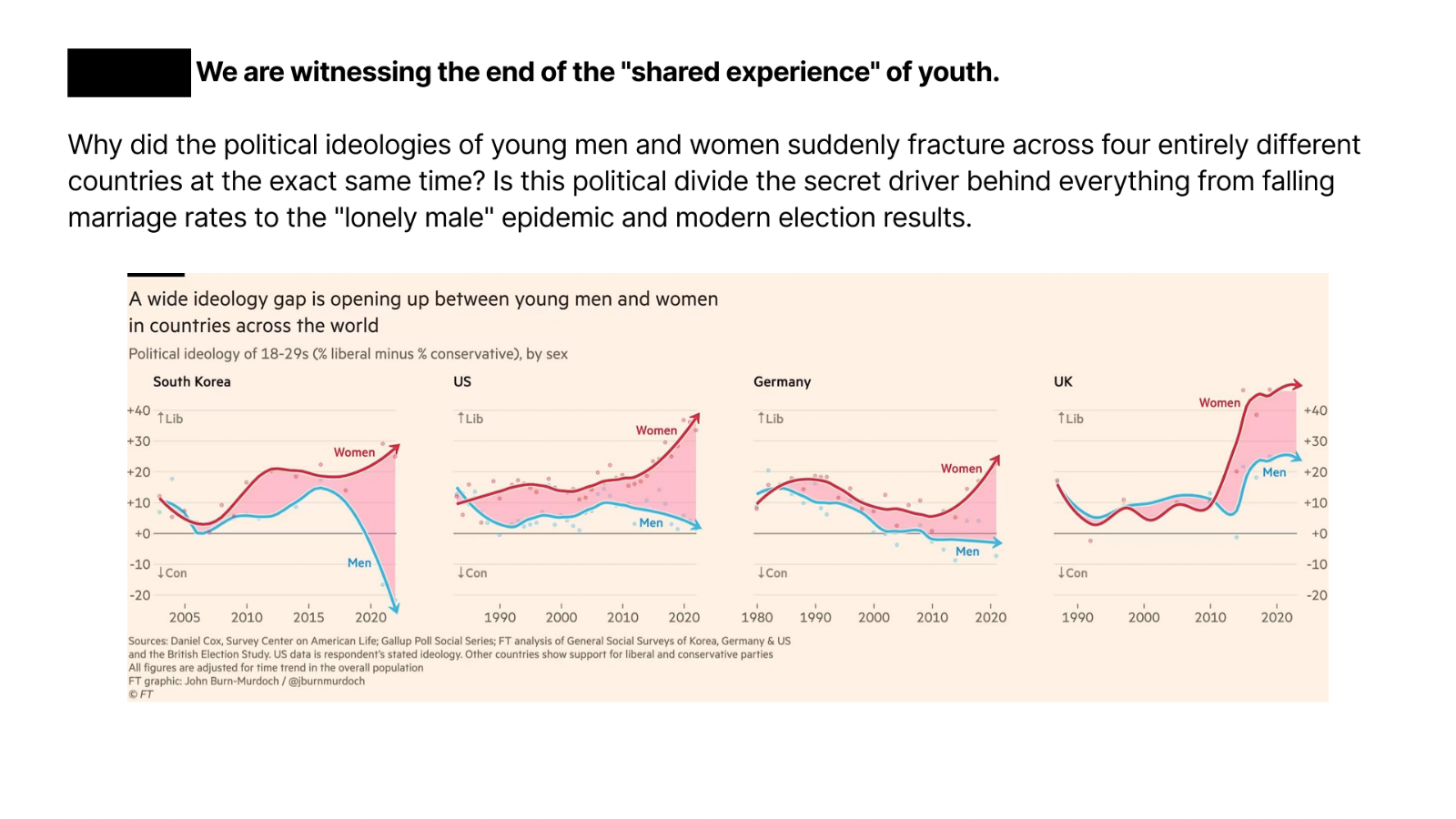
Financial Times data reveals a political chasm opening between young men and women across the globe. In the US, UK, and Germany, young women are now roughly 30 points more liberal than their male peers. In South Korea, the gap approaches 40 points, and we’re seeing the rise of the 4B movement, where women reject marriage entirely.
Social media algorithms accelerate the fracture by trapping the sexes in separate, polarizing information bubbles. Dating apps may be quietly further accelerating the divide: the platforms create radically different experiences by gender, with women overwhelmed by volume and most men starved of matches entirely. To cope, youth are turning inward to isolation or to AI relationships. The group wrestled with what this means long term: as artificial intimacy replaces human connection, the shared cultural baselines required to form families and communities quietly disintegrate.
Further reading
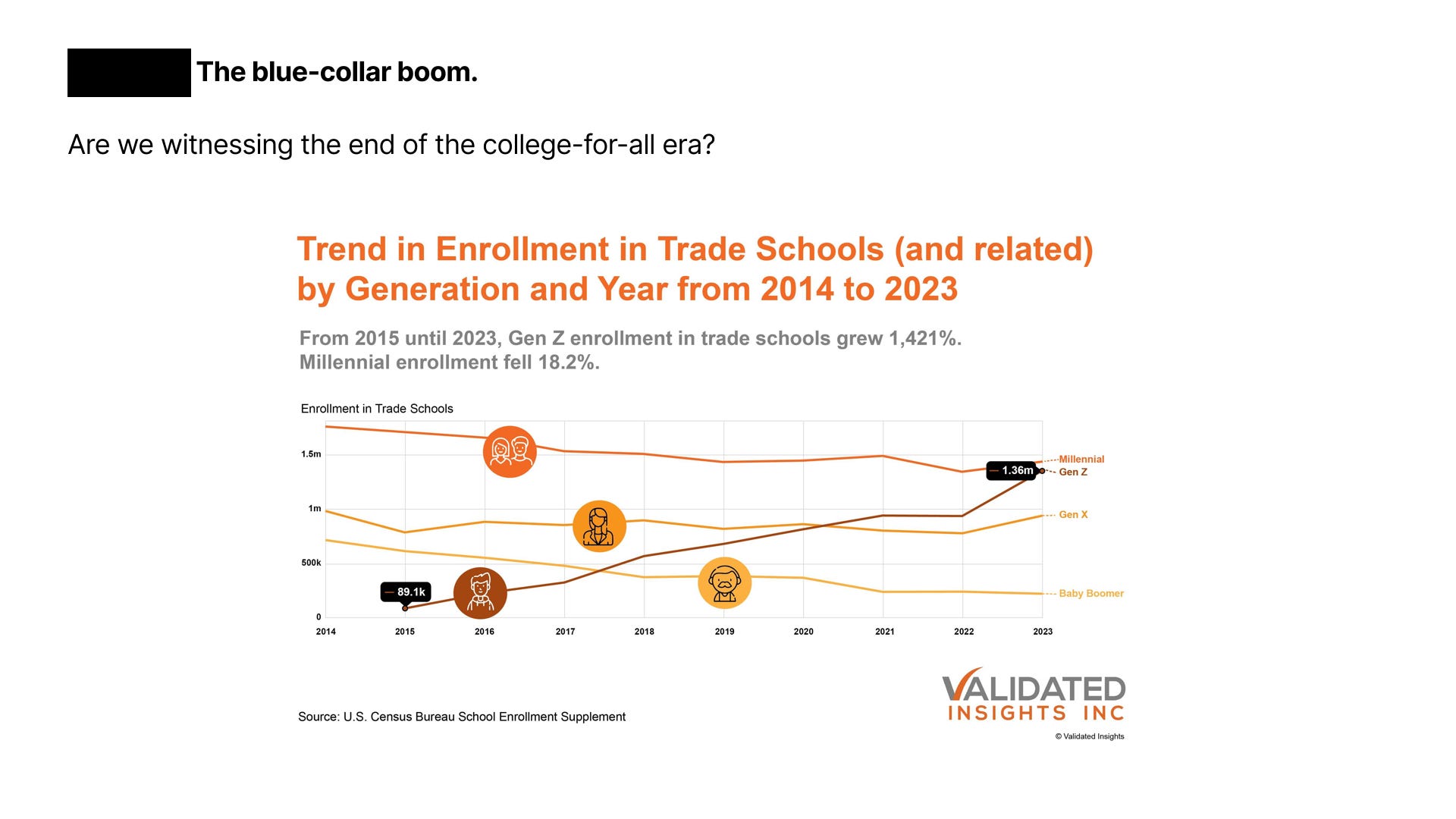
Between 2015 and 2023, Gen Z enrollment in trade schools exploded by 1,421 percent. This started long before the AI hype, driven initially by ballooning tuition and a student debt bubble that now exceeds $1.7 trillion. The group debated whether traditional four-year universities will even exist in twenty years.
There’s a painful irony at the center of this shift: the “learn to code” movement is being eaten by the automation it championed. Junior developer roles are among the first being hollowed out by AI, while an electrician or welder faces essentially zero automation risk. The silver tsunami of retiring boomers is leaving behind six-figure trade vacancies with no one to fill them. Meanwhile, a generation buried in debt for degrees that led to mid-tier knowledge work is watching peers who skipped college outearn them with no loans attached. The dinner also surfaced a deeper question: whether humans are simply wired to find more meaning in physical work. There is something about building a thing you can see and touch that a spreadsheet or a Slack thread will never replicate.
Further reading
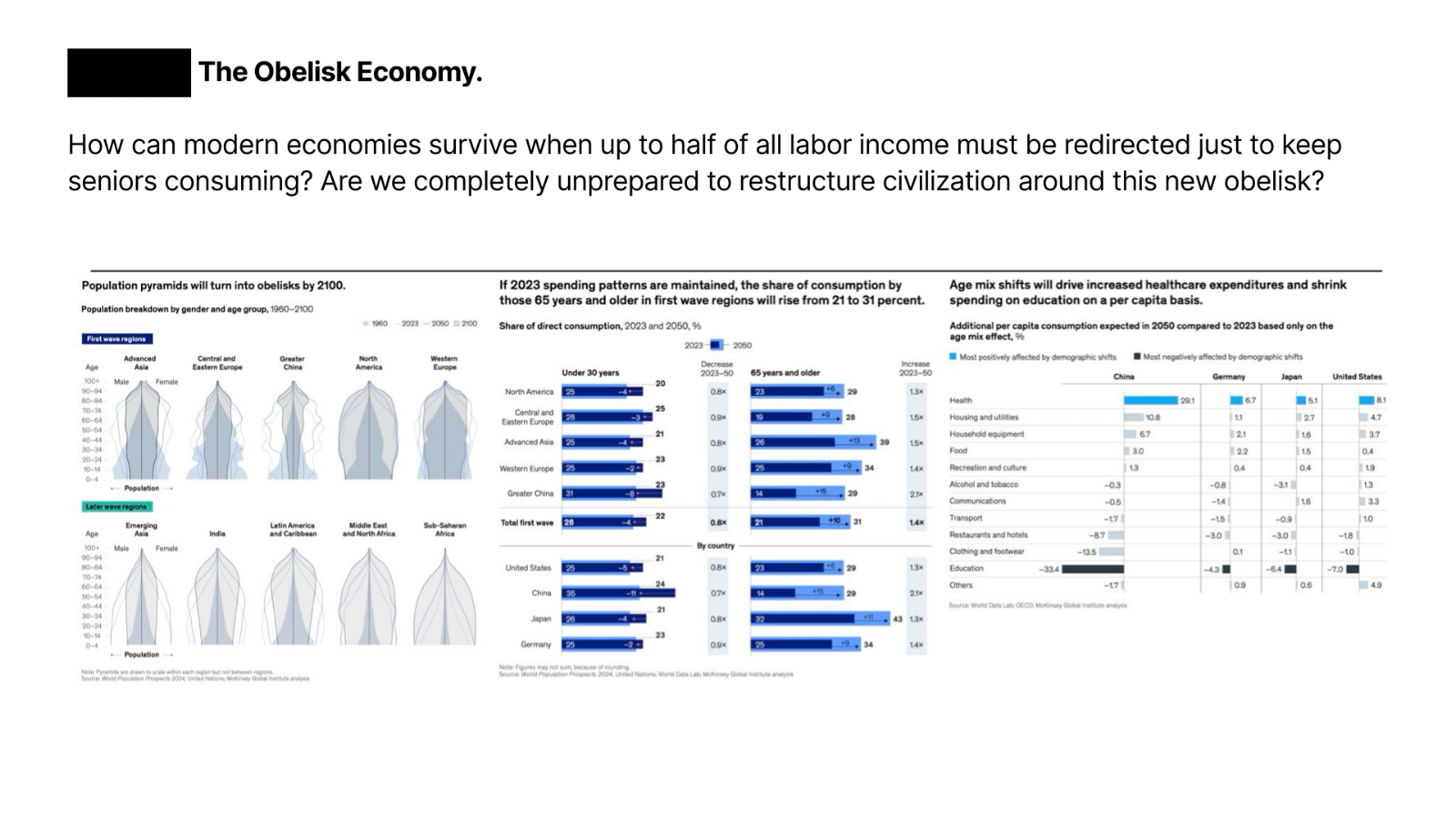
By 2100, population pyramids will flatten into obelisks, with numbers roughly equal across all age groups. In Western Europe, the share of consumption driven by people 65 and older is projected to jump from 21 to 31 percent by 2050. The UN predicts global population will begin declining in the 2080s.
The economic consequences are brutal and accelerating. Capital must be massively reallocated toward the medical maintenance of seniors, and society faces a catastrophic shortage of healthcare workers just as the senior population explodes. The impending reality of an automated, shrinking workforce sparked debate over universal basic income. Early UBI pilots show slight decreases in labor hours, and the room was split on a fundamental question: do humans work to live, or live to work?
Further reading
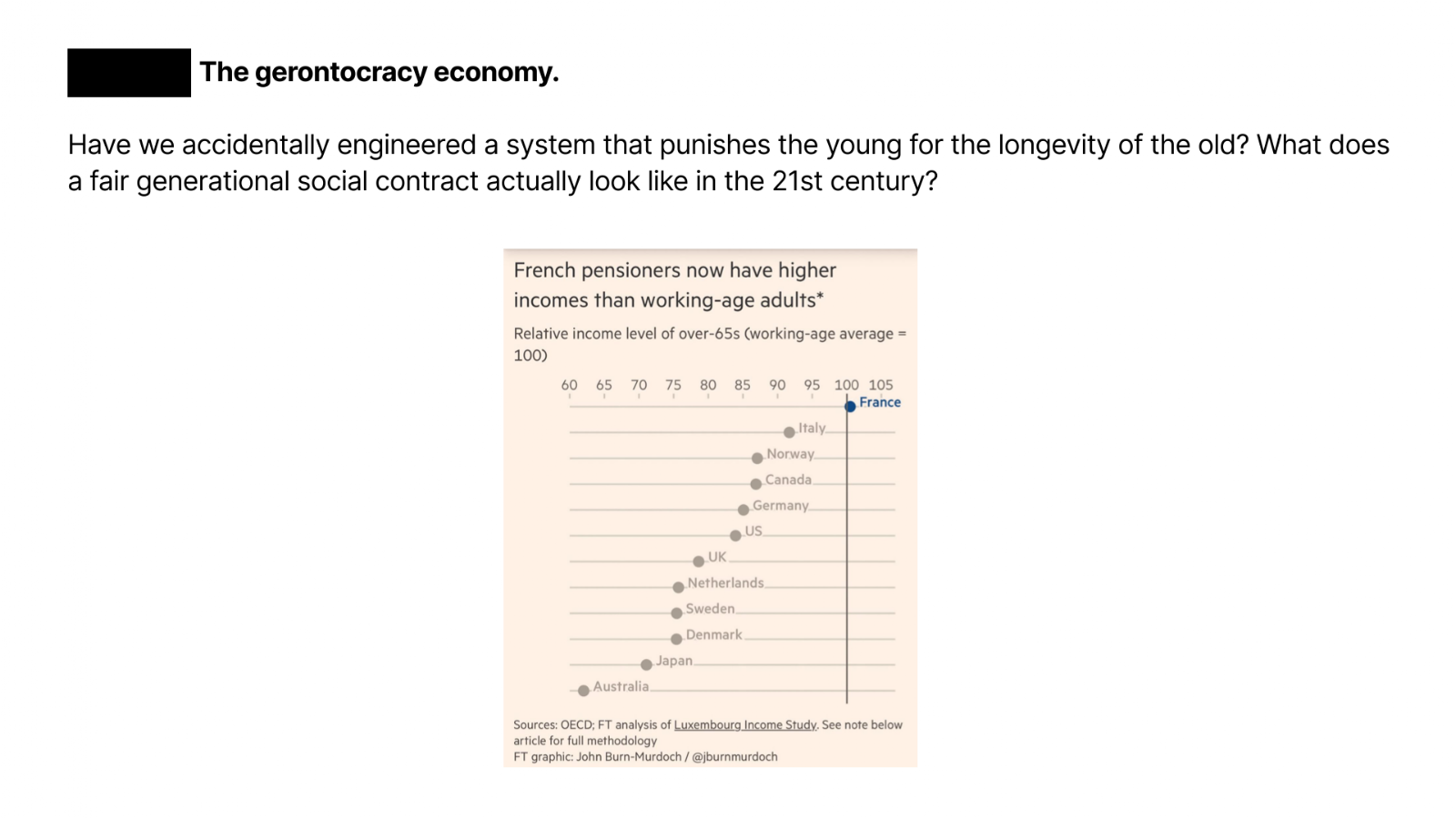
In France, the average income of pensioners now surpasses that of the working-age adults subsidizing them. The resulting pensioner democracy routinely favors the old at the expense of the young.
The discussion highlighted an irony: medical breakthroughs are compounding the problem. GLP-1 agonists and PCSK9 inhibitors are successfully eradicating metabolic disease, but extending lifespan without structural economic reform only deepens the imbalance. Society is unprepared for a reality where biotechnology keeps an aging population alive and consuming indefinitely while a shrinking workforce foots the bill. The inevitable outcome may be a generational revolt against an aging political class with no structural incentive to pass the torch.
Further reading
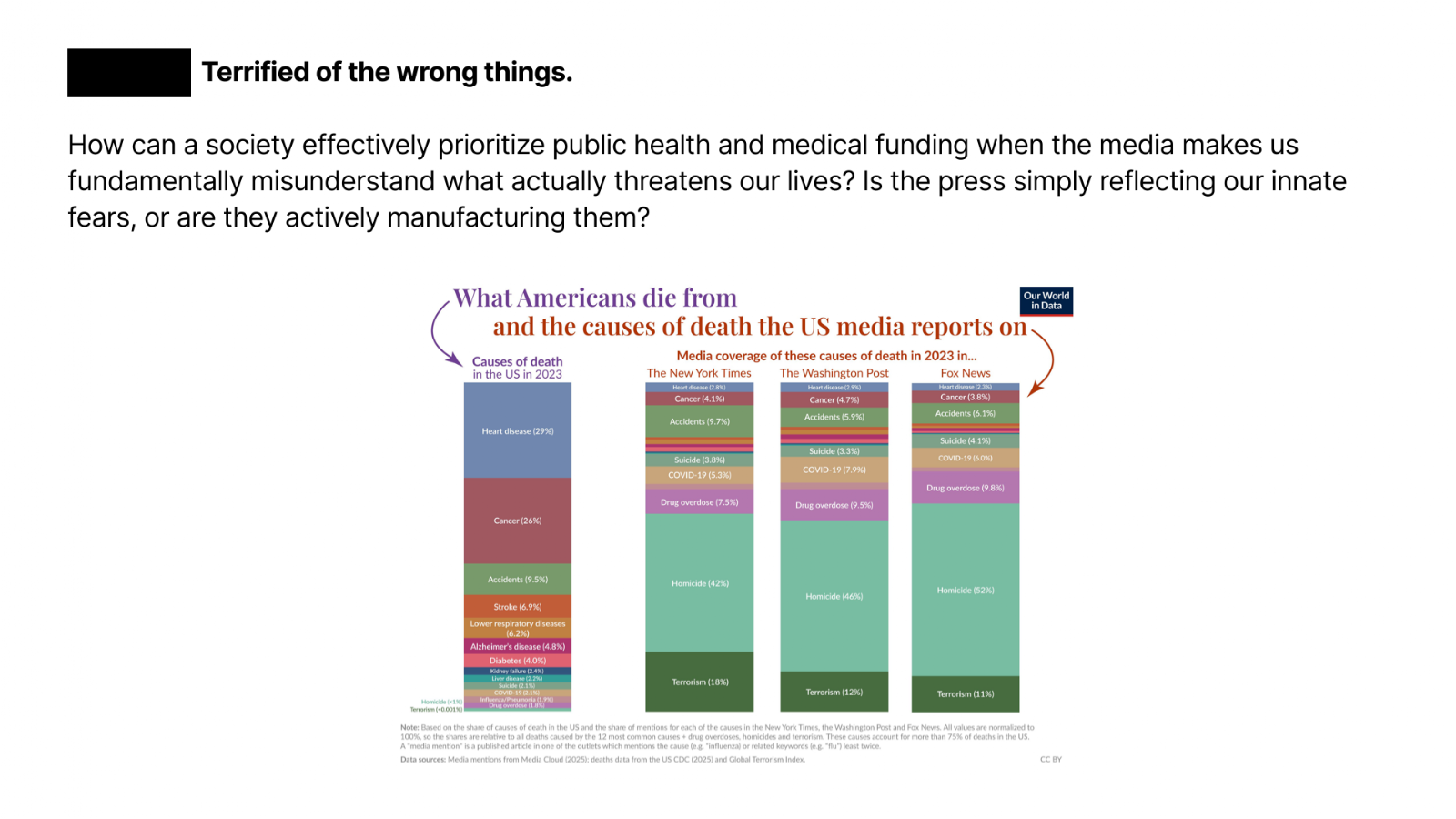
Heart disease accounts for 29 percent of all US deaths. It receives roughly 2 percent of media coverage. Terrorism commands massive attention despite causing a fraction of fatalities. Because society reacts to sensationalized algorithmic fear rather than statistical reality, it is fundamentally illogical about how it allocates attention and resources. This leads to severe underinvestment, for example in chronic disease prevention and women’s care. The group noted that as medical advances extend lifespan, a secondary underinvested in crisis looms: the modern loneliness epidemic. Digital isolation is stripping away traditional communities, and simply adding years to a life is insufficient without building the communal safety nets to support them.
Further reading
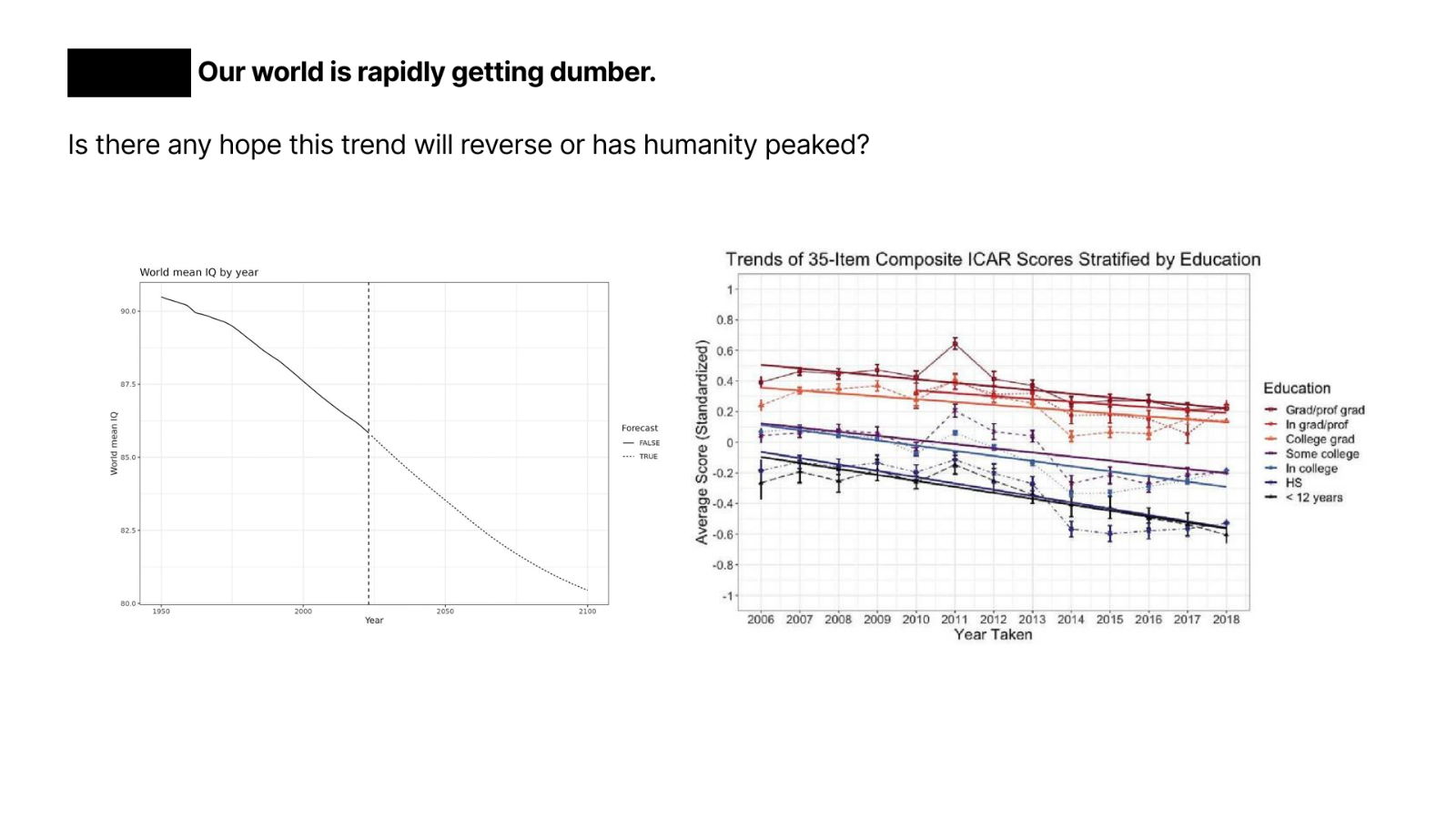
Long-term tracking data shows global IQ scores trending downward, effectively ending the 20th-century Flynn effect of constantly rising intelligence. The group debated root causes: selection bias in who takes online tests, the delayed toll of historical lead poisoning and environmental exposure, or the more uncomfortable theory: that this is the biological cost of screen addiction and outsourcing memory to smartphones.
The evidence of a collective attention crisis is everywhere, and now an entire industry exists to help people resist the devices they can’t put down: devices like Brick, screen time management apps, dopamine fasting, digital detox retreats, amongst others. And now as AI takes over more of our reasoning, we risk an even more rapid decline in our cognitive abilities.
Further reading
Brain Drain: The Mere Presence of One’s Own Smartphone Reduces Available Cognitive Capacity
Thinking in the Age of Machines: Global IQ Decline and the Rise of AI-Assisted Thinking
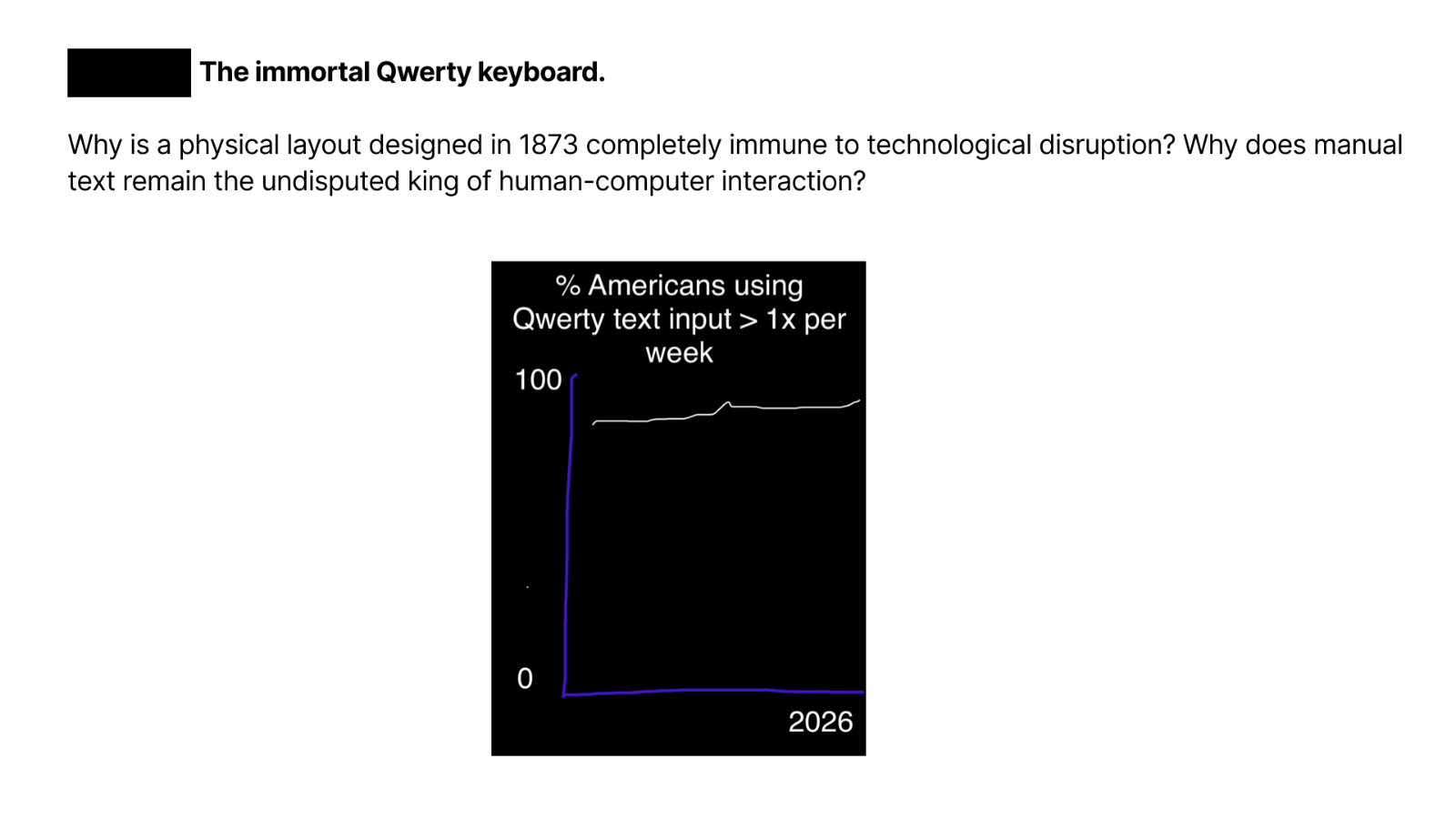
We have had touchscreens, voice assistants, gesture controls, and styluses. Yet the primary way humans communicate with computers is still typing text on a layout designed in 1873.
That is starting to change. In Latin America and South Asia, voice has long been the default mode of digital communication. Younger generations everywhere are following, and now AI transcription has gotten good enough that voice is becoming a viable computer input too. The real disruption, though, may skip voice entirely. Recent Apple patents explore embedding brainwave sensors directly into AirPods, and Neuralink is pushing brain-computer interfaces toward commercial use. The end state could communicating with machines and each other at the speed of thought. The group was fascinated by the trajectory but largely agreed they were a long way from letting a company wire into their brain.
Further reading
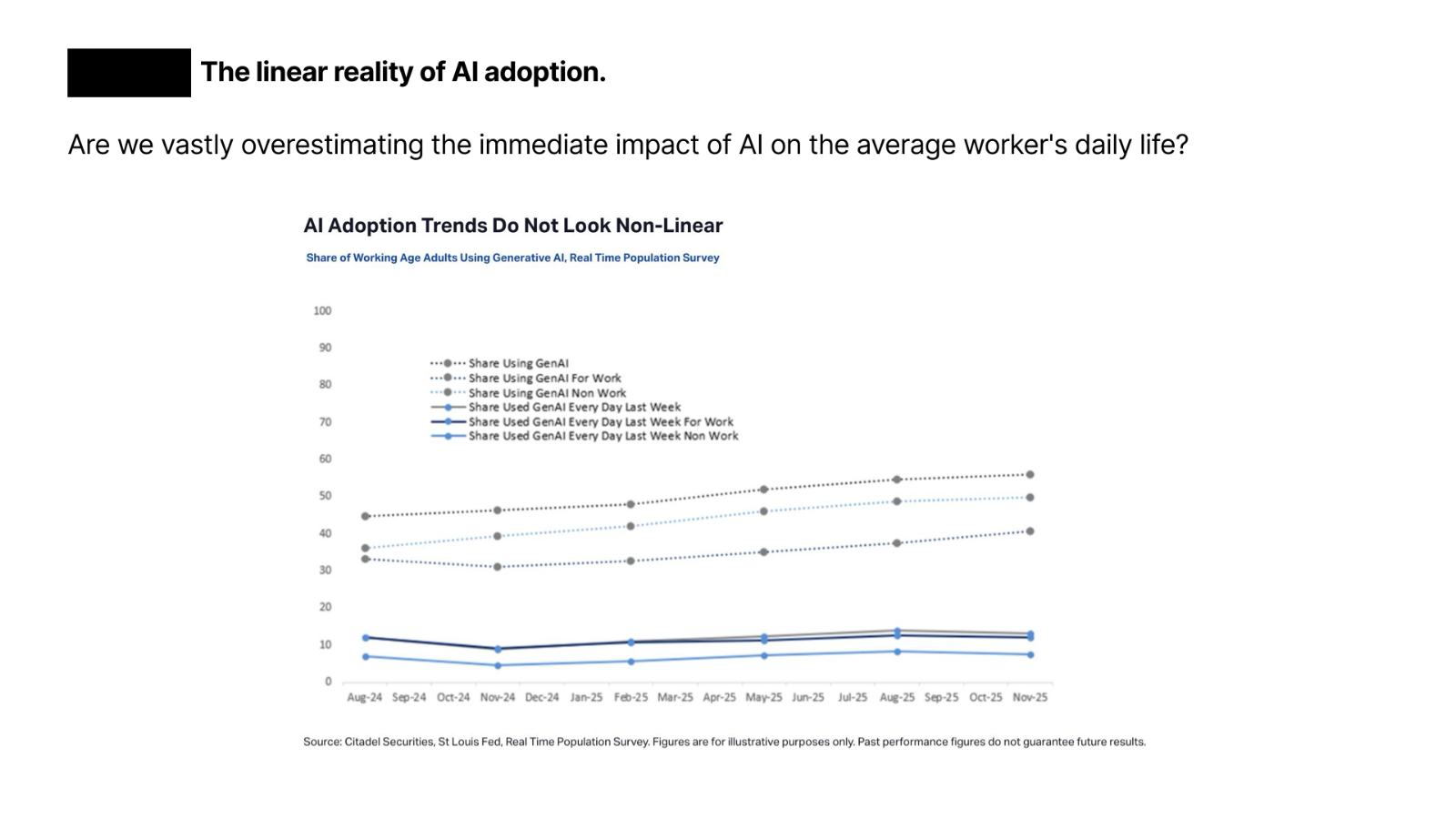
If you only read headlines, AI should have already gutted the white-collar workforce. St. Louis Fed survey data shows that daily use of AI at work has barely moved since mid-2024.
The table spent a long time on why. Code generation has exploded because developers were already comfortable with the tooling, but nobody could name a second vertical with that kind of adoption. Energy infrastructure, enterprise compliance, and the sheer bureaucratic friction of getting large organizations to change how they work keep slowing everything down. Several attendees pointed out that many layoffs currently blamed on AI are really companies trimming bloated pandemic-era headcounts with a convenient narrative attached. The room agreed the impact on junior workers is real and accelerating, but most pushed back hard on the doomsday framing. The macro transition will be a slow, grinding structural shift, not the overnight collapse that makes for good engagement online.
Further reading
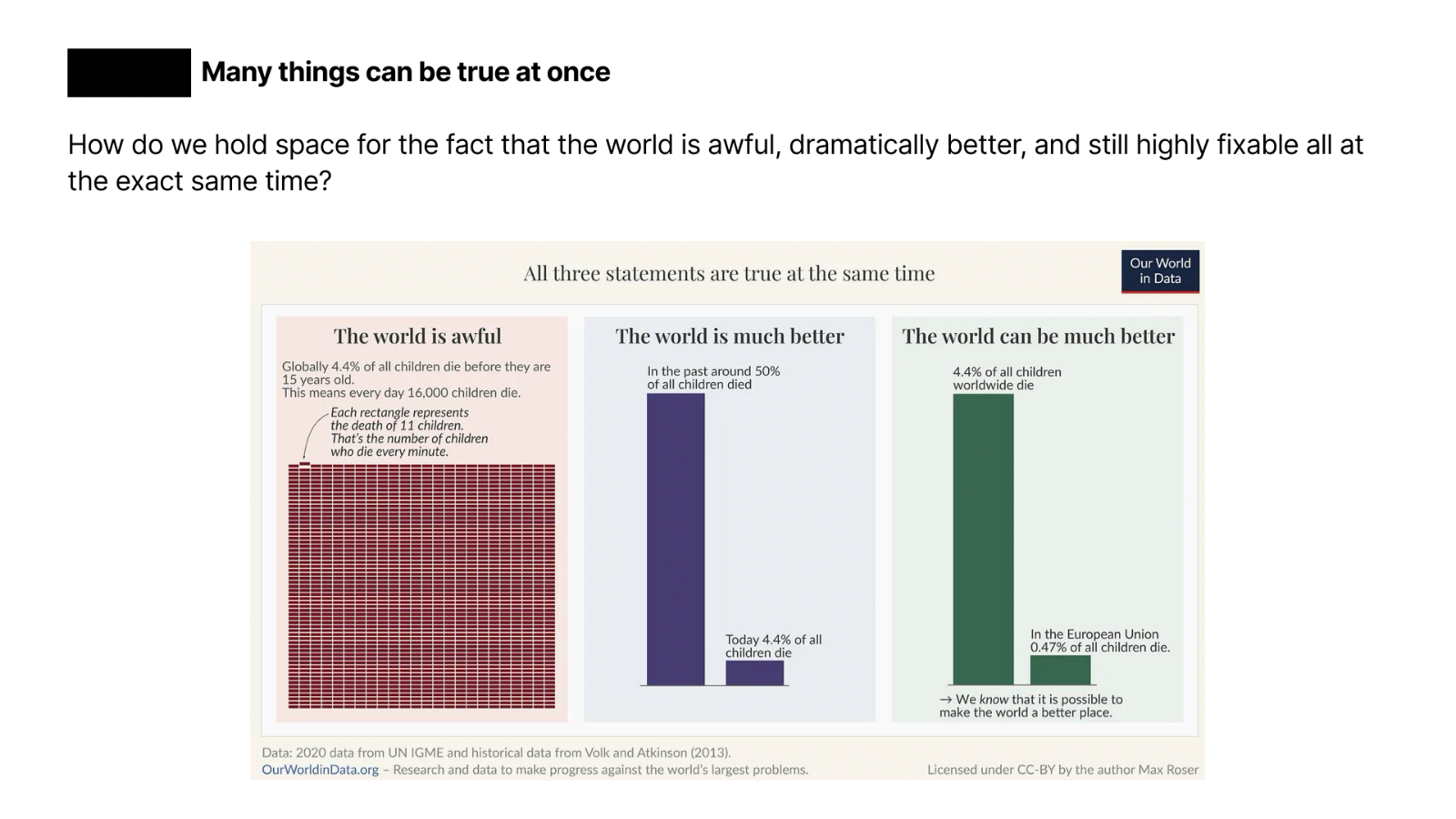
The final chart of the evening reframed everything that came before it. The world is, by almost every measurable dimension, better than it has ever been. And yet 16,000 children still die every day, and those deaths are very unevenly spread across the globe. All of those things are true at the same time.
This is the tension modern society struggles to sit with. We are wired for simple narratives. Algorithms reward outrage and optimism in equal measure, but nuance gets no engagement. The dinner conversation kept circling back to this problem across every topic. The world is awful. The world is dramatically better. The world is highly fixable. Holding all three simultaneously is uncomfortable, but this is the kind of nuance we need to bring back to public discourse.
Further reading